Roller count and material
A full set of ten rollers on a double door is a different job than replacing three that are chipped or flat-spotted on one side, and steel rollers versus sealed nylon ones change the parts cost too.
Coeur d'Alene, ID
Worn rollers on Coeur d'Alene garage doors tied to 1950-2003 housing stock and cold winters. Local causes, signs, and what a straight repair runs.
Local causes
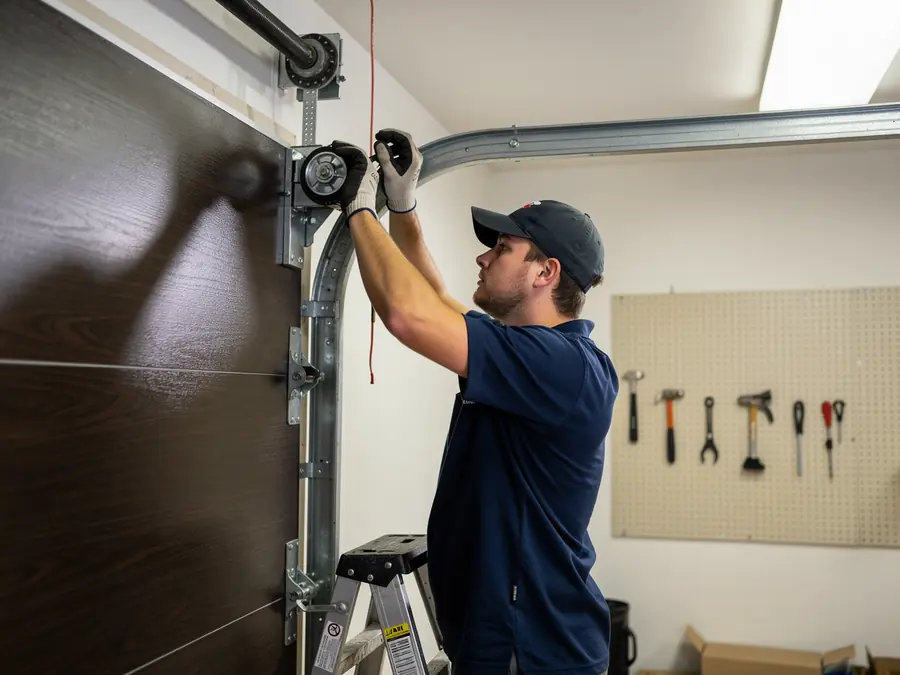
Rollers wear out faster here than the glossy brochures suggest, and the reason is in the housing stock. Most of the doors we get called on sit in homes built between 1950 and 2003, with a heavy cluster from the 1980s and 90s across the six main pockets of the service area. That generation of door came with steel rollers riding in steel tracks, sometimes with a thin nylon sleeve if the builder upgraded, and neither holds up forever against freeze-thaw cycles.
Coeur d'Alene sits in a cold, moderate climate band, which means the garage goes through repeated swings - damp mornings, hard overnight freezes, then a thaw that pulls moisture back into the track. That cycle rusts steel rollers and stiffens nylon ones, and it happens whether the door gets used twice a day or twice a week. A door that sat fine all summer starts grinding the first cold stretch of the season because the rollers picked up just enough rust or debris to bind in the track.
Houses from the 1980s and 90s also tend to have tracks that were never resquared after decades of seasonal movement, so a worn roller doesn't just squeak - it starts riding the edge of the track and accelerating its own wear. That combination, old stock plus cold cycling, is why this is one of the most common single-part calls we take across the area, not a rare failure.
Pricing
We don't post a flat number for roller replacement because the job splits into a few different scopes and we're not going to pretend otherwise.
A full set of ten rollers on a double door is a different job than replacing three that are chipped or flat-spotted on one side, and steel rollers versus sealed nylon ones change the parts cost too.
What we can tell you is the honest version: if you're only getting this one part fixed and the track and hinges are still square, it's a short job - most of the time is spent pulling the old rollers out from under the hinges without bending anything, not screwing in new ones.
If the rollers wore unevenly because the track itself is out of alignment, that's a second problem riding along with the first, and fixing just the rollers without touching the track means you're back here again within a year or two. Give us a call and we'll give you a real number for your door, not a range pulled from a national price list that doesn't know what climate or housing era you're dealing with.
Warning signs
It starts as a sound before it's a failure. A grinding or rattling noise right as the door passes the bend in the track - where horizontal meets vertical - is almost always a roller losing its round shape or picking up enough rust to bind.
On older steel-roller doors common in the 1980s and 90s builds around here, that grinding often shows up worse on cold mornings and eases up once the garage warms a few degrees, which is the moisture-and-metal story playing out in real time.
You'll also see it visually if you watch the door cycle: a roller that's gone flat on one side makes the door wobble slightly as it travels, instead of running smooth and level. Left alone, a flat-spotted roller puts uneven load on the hinge it's attached to, and that hinge can crack next - which turns a simple roller swap into a hinge-and-roller job.
The other common sign is a roller that's visibly chipped or cracked at the edge. Nylon rollers on older installs get brittle with age and cold, and a cracked roller can shed small chips into the track, which then act like gravel under the next roller in line and speed up wear on its neighbors.
DIY or pro
Swapping a roller or two isn't a complicated job mechanically, and plenty of homeowners in the area handle it themselves on a standard extension-spring door with the garage door disconnected from the opener and the door resting on the floor. The part itself is cheap and the hinge bolts come out with a socket wrench.
Where we tell people to stop and call instead: anything involving the two rollers closest to the bottom bracket on a door under spring tension, and anything on a door with torsion springs where you'd need to remove hinges near the cable. Those jobs put your hand near a loaded cable or a hinge that's holding tension, and that's not a place to learn by trial and error.
The other honest limitation - if your rollers are failing because the track is bent or badly out of square, which we see on a fair number of houses from the older end of our 1950-2003 range, swapping rollers alone won't fix the actual problem. We'll tell you that straight rather than sell you a roller job that doesn't last.
Questions
In this area it's usually the combination of an older steel or nylon roller, common in homes built through the 1980s and 90s, and the region's cold, moderate swings between damp mornings and hard freezes. That cycle rusts steel and stiffens nylon faster than it would in a milder, drier climate.
Yes, if the rest of the rollers are still round and running quiet, replacing only the worn ones is reasonable and saves money. We check the whole set when we're out there so you're not paying to fix the same problem twice within a year.
It can usually wait a short while, but a grinding roller puts extra load on its hinge, and a cracked hinge is a bigger repair than a roller. If the noise is new and getting worse week to week, it's worth getting looked at before it takes the hinge with it.
Explore more
Ready when you are
Coeur d'Alene Garage Door Pros repairs and installs garage doors, springs and openers in Coeur d'Alene, ID and the surrounding area.